What is a Robotic Assembly Line? A Guide for SMEs
Statistics show that small- and medium-sized enterprises (SMEs) can be up to 60% less efficient than larger manufacturers, which is attributed to a lack of automation. Fortunately, modern robotic technology is no longer just for large corporations. Flexible, affordable and user-friendly collaborative robots (cobots) are breaking down old barriers, allowing SMEs to automate so they can increase efficiency and maximize their ROI.
This blog will explore robotic assembly lines – a manufacturing setup where robots or cobots perform tasks to assemble a product, often working alongside humans – and how robotic assembly can help boost the efficiency of small- and medium-sized operations.
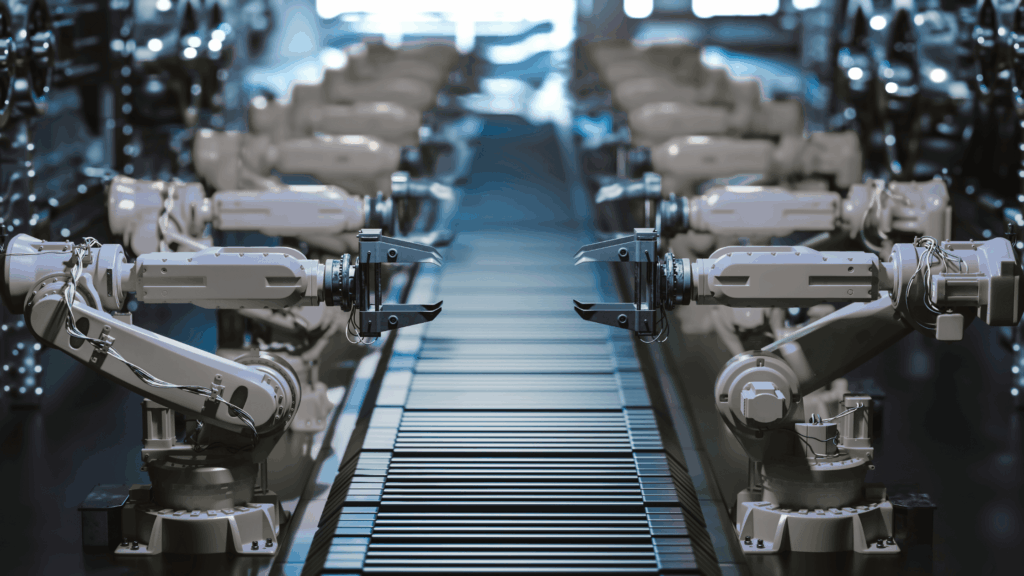
The Robotic Assembly Process: What Tasks Can Be Automated?
Assembly robots are designed to accurately grasp, move and manipulate parts and components with high precision. On automated assembly lines, robots and cobots are used to:
- Precisely fit parts together.
- Apply adhesives and sealants.
- Install screws, bolts or rivets to secure components.
- Perform quality control inspections usually using vision systems.
- Pick and place parts or products.
- Weld.
- Material handling.
Overcoming Barriers: Traditional Robots vs. Cobots
In the past, SMEs faced significant challenges that prevented them from installing automation.
Traditional Roadblocks to Automation for SMEs
- High cost: Lack of financial resources for large upfront investments and permanent infrastructure changes.
- Lack of expertise: No in-house experts to program, operate and maintain complex traditional robots.
- Lack of flexibility: Traditional robots are often permanent and inflexible, which doesn’t work for diversified or seasonal products.
Fortunately, modern assembly cobots are specifically designed to knock down these barriers.
The Modern Solution: Flexible Collaborative Robots
- Affordable and accessible: Collaborative robots may have a lower upfront cost, making ROI faster and automation attainable.
- User-friendly: Cobots were developed to be easy to install, program and operate, reducing the need for dedicated robotics engineers.
- Flexible and re-deployable: Cobots are easy to reprogram and relocate to different tasks to accommodate changing production needs.
- Adaptable: An assembly line robot arm can be equipped with different end-of-arm tooling, such as grippers or screwdrivers, to perform a variety of jobs.
- Safe collaboration: Designed with special sensors to allow safe operation alongside human employees, cobots usually do not require expensive caging and safety infrastructure.
Advantages: How Robotic Assembly Lines Benefit SMEs
While the cost and complexity of traditional automation was tough for SMEs to justify, today’s assembly robots and cobots deliver clear, measurable benefits for small- and medium-size manufacturers, including:
Maximized efficiency: Robots and cobots work continuously at high speeds without breaks or fatigue, dramatically enhancing the speed and throughput of your assembly line.
Improved quality & consistency: Assembly robots and cobots provide high accuracy and repeatability, ensuring each part is assembled to exact specifications every time. Vision-equipped robots can also inspect products, providing better quality control than the human eye.
Minimized costs: Higher accuracy means fewer assembly errors, costs related to material waste and labor for re-work.
Enhanced safety: Automating hazardous, repetitive or physically demanding tasks that cause injuries reduces workplace accidents. Cobots have built-in safety features to prevent collisions, minimizing risks to human workers.
Offset labor shortages: With skilled workers hard to find, robots and cobots can manage repetitive tasks, allowing you to re-assign employees to more complex, value-added and satisfying roles.
Increased competitiveness: By producing higher volumes of better-quality products in less time, you can get to market faster and compete with larger businesses.
Which Robot Type is Best for Your Assembly Line?
The “best” robot type depends on your application requirements regarding speed, payload, reach and flexibility. Here we break down the most common assembly robots.
Collaborative Robots
Cobots are ideal for working directly with human operators, handling flexible tasks and managing lower-payload assembly.
SCARA Robots
SCARA robots are well suited to high-speed, high-precision, repetitive tasks such as small part assembly or pick-and-place, typically on a horizontal plane.
6-Axis Robots
Six-axis robots offer the greatest flexibility and reach, mimicking a human arm. They are ideal for complex assembly, welding or handling parts at odd angles.
Learn more about the differences in our SCARA Robot vs. 6-Axis Robot blog post.
Calculating the ROI of Assembly Line Robots
Cost justification is one of the biggest obstacles to automation for SMEs. But, modern automation solutions offer a faster ROI, making it possible for small and medium enterprises to reap the rewards of robotic assembly lines.
How Much Do Assembly Robots Cost?
The cost of an assembly robot varies significantly based on the robot type, as well as its payload, reach, end-of-arm tooling and integration complexity. Cobot systems, however, usually offer a lower barrier to entry than traditional industrial robots.
For more information on robot cost, contact JHFOSTER for a quote today.
How to Maximize Your Return on Investment (ROI)
Many SMEs find that the return on investment for an assembly line robot or cobot is about two years. Return on investment is achieved due to:
- Reduced direct labor costs.
- Increased production volume and throughput due to higher speeds.
- Reduced scrap, waste and rework costs due to higher levels of accuracy.
- Fewer workplace injuries result in lower workers’ compensation, healthcare and insurance costs.
- Greater employee satisfaction reduces employee turnover.
You can calculate your anticipated ROI using our free automation calculator.
Your Partner in Robotic Assembly Automation
JHFOSTER is more than a distributor, we are your partner in automation. Our experts support you through the entire lifecycle of your automation project. We will assess your current assembly process to identify the best opportunities for automation. Our engineers will design a tailored robotic solution using the right cobot or robot and tooling for your specific application. We will install and integrate the system into your existing workflow and provide training and service to ensure your system continues to run reliably and efficiently.
Ready to start operating smarter? Contact us today to discuss your robotic assembly project or to request a quote.