What are Rotary Dampers Used for in Industrial Automation?
Achieve greater precision and control and extend the life of rotating components by using rotary dampers, which smoothly and safely regulate rotational motion by absorbing kinetic energy.
Read on to learn about the role of rotary dampers in industrial automation and why you should partner with JHFOSTER for the selection, sizing and integration of a rotary damper when you need to achieve the highest levels of performance, safety and efficiency in your motion control project.
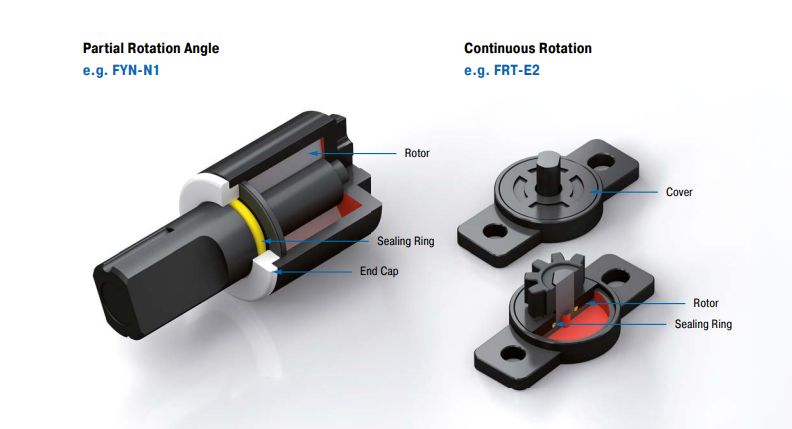
What is a Rotary Damper?
A rotary damper is a device that regulates rotational motion via resistance (technically called damping torque). A viscous fluid, usually a silicone oil, is contained inside a sealed enclosure where internal components, such as a vane or gear, “stir” the fluid, creating resistance in order to produce slower, smoother movement of mechanical components. The viscosity of the oil determines the damping torque.
Using this method of operation, rotary dampers prevent slamming, jarring and vibration, increasing reliability and safety and extending the life of equipment.
What is the Main Purpose of a Damper?
Dampers dissipate kinetic energy and prevent uncontrolled movement of mechanical systems, enabling smooth, quiet and reliable operation of components such as covers, lids, drawers and other moving mechanisms.
How are Rotary Dampers Used?
Rotary dampers improve performance and protect components in machinery in the following ways:
- Speed Control: Rotary dampers regulate the speed of rotating parts in industrial equipment.
- Soft Closing/Opening: These devices provide controlled, slow motion for lids, covers and access panels on printers, automotive interiors, appliances and other machines.
- Noise Reduction: They eliminate the loud noise associated with components slamming shut.
- Component Protection: Rotary dampers minimize wear and tear caused by impacts and sudden movement, ensuring productivity.
What is the Difference Between a Linear Damper and a Rotary Damper?
While the function is the same – to regulate motion in equipment components – linear and rotary dampers serve different purposes, so it’s important to understand which device your system requires.
- Linear Dampers: These restrict straight-line motion, allowing separate speed settings for extend and retract. Commonly used for drive compensation or safety.
- Rotary Dampers: These control rotational motion of components such as small lids compartments or drawers. Protecting sensitive components and reducing noise.
How Do Linear Dampers Work?
Linear dampers provide resistance against straight-line motion, typically using a fluid and piston/chamber mechanism. Linear dampers provide control to achieve smooth, consistent motion and protect components from sudden impacts or uncontrolled movement.
JHFOSTER can equip you with both linear and rotary actuators and dampers as your application dictates.
Damper Types and Classifications
Dampers may be categorized by internal mechanism or operational method.
What are the Different Types of Rotary Dampers?
When categorized by internal mechanism, the types of rotary dampers include:
- Vane Dampers: These are used for controlling limited-angle rotation of less than 180° and are commonly used in soft-closing applications.
- Gear Dampers: Gear dampers support full rotation and are often used to prevent harsh stops in machinery and robotics.
- Barrel/Radial Dampers: The dampers decelerate motion to prevent slamming and sudden impacts of lids and covers.
How are dampers classified?
Dampers may also be classified by their operating medium, which include mechanical dampers or hydraulic/fluidic dampers. Fluidic dampers that use viscous fluids, such as silicone oil, are most often used in heavy-duty machinery and industrial equipment applications.
How to Specify a Rotary Damper?
Selecting a rotary damper involves evaluating several key factors, including:
- Damping torque: This is the most critical factor when selecting a rotary damper and refers to the required resistance.
- Operating angle: Dampers are available to support full 360° rotation or limited-angle rotation.
- Operating speed: Higher speeds result in lower damping force.
- Temperature: Because dampers rely on a viscous fluid for operation, temperatures in the application can affect performance. Ensure the selected damper will function within the temperature range of the application.
How Do I Know What Size Damper I Need?
Partner with JHFOSTER to take the guesswork out of sizing a rotary damper. We use our engineering expertise to calculate the required torque and select the optimal damper model, ensuring precision, reliability and proper performance for your specific application.
Get Assistance with Rotary Damper Selection from the Pros at JHFOSTER
Rotary dampers are critical components for achieving precise, safe and reliable motion control systems. Ready to incorporate precision motion control in your next project? Contact JHFOSTER today for a tailored solution and start operating safer, smarter and more efficiently.