What Are Hydraulic Dampers Used for in Industrial Automation?
How can you move heavy loads quickly without damaging your equipment? Hydraulic dampers are critical motion control components designed to provide precision speed and longevity in automation systems by safely absorbing and dissipating kinetic energy.
You can rely on JHFOSTER, your expert partner in automation, to help evaluate, design, integrate and support the right motion control components – including hydraulic dampers – for your specific application. This blog will explain the role of dampers and why you may need them in automation systems.
What is the Purpose of a Damper?
Dampers are used to reduce oscillation, vibration or sudden forces. In automation systems, the primary purpose is to safely and smoothly bring a moving mass, such as a robotic arm or conveyor pallet, to a controlled stop, preventing impacts and vibrations.
In this way, dampers increase system longevity and maintain precision by safeguarding machinery from the wear and tear caused by repeated, uncontrolled impacts.
What is a Hydraulic Damper?
Hydraulic dampers are mechanical devices that use a viscous oil, namely hydraulic oil, and a piston to convert kinetic energy (movement) into thermal energy (heat). This provides a controlled resistance force proportional to the speed of the piston’s movement, ensuring smooth deceleration.
In automation systems, hydraulic dampers may also be referred to as industrial shock absorbers or hydraulic dashpots.
How Do Hydraulic Dampers Work?
When an external force impacts the damper, a piston is pushed into a sealed cylinder that is filled with hydraulic oil. The oil is forced to move through small orifices in the piston. The restricted flow of the viscous oil creates resistance that slows the piston’s movement. This resistance is what dissipates the kinetic energy of the moving object, slowing down its motion to prevent sudden impact.
What Does a Damper Look Like?
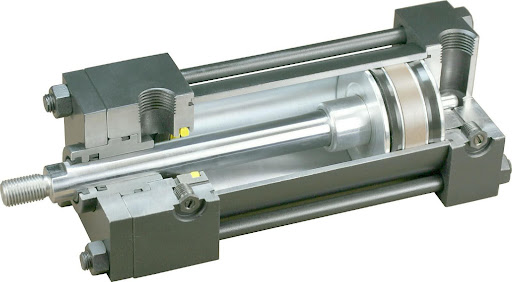
The internal components of a damper, such as a piston rod, piston and oil chamber are contained inside a cylinder, so dampers resemble a small hydraulic cylinder or an automotive shock absorber.
Dampers are available in different sizes and mounting styles, such as threaded body or flange mounts, to accommodate a variety of industrial applications.
What are the Three Main Types of Dampers?
There are three main types of dampers, which are based on their operational mechanisms:
Hydraulic dampers: These use fluid/oil for resistance.
Pneumatic dampers: Compressed air/gas is used for resistance.
Friction dampers: These dampers rely on solid-on-solid friction to provide resistance.
Hydraulic dampers are often specified in industrial automation applications because they offer high levels of energy absorption to provide precise, stable damping over a long lifespan.
What are the Different Types of Hydraulic Dampers?
In industrial automation applications, adjustable dampers, self-compensating dampers and heavy-duty dampers are most common.
Adjustable dampers allow the user to manually tune the damping force using an external adjustment screw. This provides flexibility for variable automation loads or speeds.
Self-compensating dampers automatically adjust to different impact conditions, such as load and speed, within a certain range without manual adjustment. Self-compensating dampers are applied in machines with load variations to simplify setup and maintenance.
Heavy-duty/specialized dampers are designed for extremely high-impact energy absorption, such as in cranes and other heavy-duty machinery.
What are the Two Types of Suspension Dampers?
There are two main types of suspension dampers – hydraulic/oil dampers and gas-charged dampers – used in industrial automation systems.
Hydraulic dampers, which rely on an oil-filled cylinder to provide resistance, are often used in industrial automation because they offer stable damping that brings automated equipment, such as a robotic arm, to a smooth, controlled stop. This helps to extend the life of the equipment and ensures performance and safety.
Gas-charged dampers contain low-pressure inert gas with the oil to control motion and absorb shocks, which is crucial for effective performance and longevity of industrial machinery.
What is an Example of a Damper Used in Automation?
Dampers are used in industrial equipment to protect machinery, improve performance and enhance safety. Some applications include:
Robotics: Dampers cushion the end of the stroke on linear actuators, protecting the joints and end-effectors of robotic arms.
Conveyors/transfer lines: Here dampers are used to safely stop heavy pallets or fixtures at assembly points.
CNC machine tooling: In these applications, dampers rapidly and smoothly decelerate components as they move into position.
What is the Difference Between a Hydraulic Damper and a Gas Spring?
While both are automation system components, they serve different purposes.
Hydraulic dampers absorb energy in order to slow motion. They serve to decelerate/cushion machine components.
Gas springs store energy to assist motions like lifting or counterbalancing components.
Is a Hydraulic Damper Better than a Spring?
In industrial automation, the application dictates whether a hydraulic damper or a spring is appropriate. Hydraulic dampers are used when a heavy load requires controlled deceleration to reduce impact or vibration. Air/gas springs are typically employed for lifting equipment components.
What is the Difference Between a Hydraulic Damper and a Strut?
Struts are structural components that may incorporate dampers, but are mainly used to support the load/structure of the system. Hydraulic dampers are not structural components, rather they absorb shock to control movement and dissipate energy.
Is a Hydraulic Damper Better than a Strut?
Hydraulic dampers are used solely for the purpose of controlling motion and dissipating energy, while struts provide both damping and structural support. Which device should be used depends upon the requirements of the application.
When the precision and longevity of your automation system is non-negotiable, call on JHFOSTER, your partner in automation, to help select and size the hydraulic damper that’s right for your application.