Boost Precision and Productivity with End-of-Line Testing Automation
To succeed in the competitive and cost-conscious manufacturing industry, every final product must meet strict quality standards. Manual end-of-line (EOL) testing, the final quality check before packaging and shipping, often yields inconsistent results and disappointed customers.
Automating end-of-line testing boosts accuracy and precision, enabling higher levels of quality control. As your partner in automation with experience in EOL test integration, JHFOSTER can tailor an EOL automation solution that will safeguard your brand reputation.
Why is End-of-Line Testing Automation Important?
Automated EOL testing uses equipment such as robotics and vision systems to efficiently and accurately perform quality testing before products are packaged and shipped, ensuring every product meets specifications before reaching customers.
The precision of automated EOL testing delivers tangible benefits, including:
- Reduced costs: Precise automation eliminates scrap, labor costs for manual quality checks, and costly recalls.
- Increased precision and speed: Robots and automated systems perform tests faster and with higher levels of accuracy than human inspectors, ensuring every product meets exact specifications.
- Reduced failure rates: Catching defects at the source prevents failures in the field, protecting your brand reputation.
- Enhanced data collection: Automated systems log every test result for traceability and compliance.
Key Components in End-of-Line Test Cells
EOL test cells are custom-integrated systems that contain a variety of equipment based on the application. Typical components include:
Robotics/material handling equipment
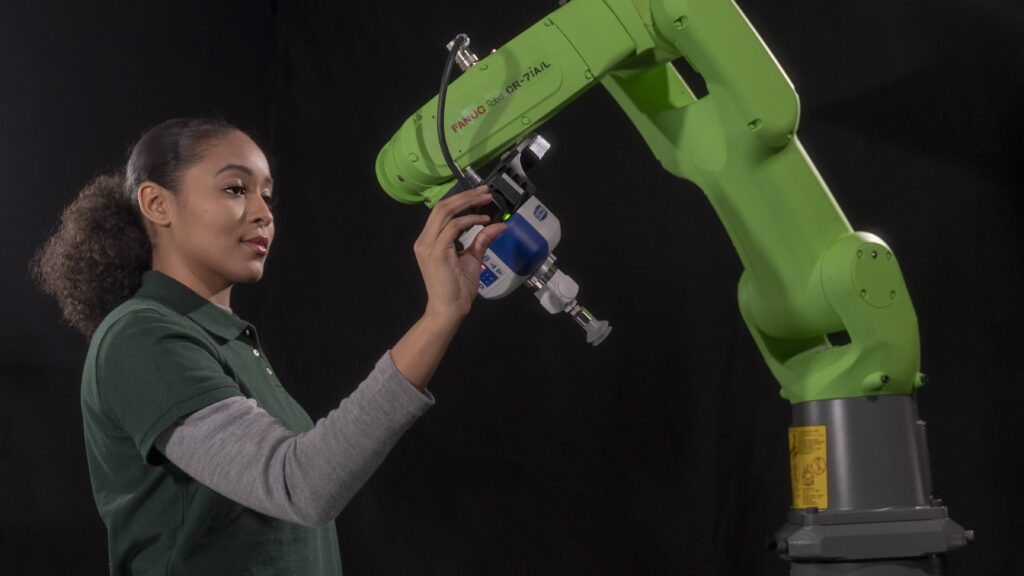
Collaborative robots (cobots) or industrial 6-axis robots may be used to move parts into the test fixture.
Sensors and vision systems
High-precision sensors and/or cameras are used for dimensional checks and inspections.
Test fixtures/jigs
Custom mechanisms securely hold parts during testing procedures.
Control panel and software
Our UL 508-certified panel shop builds the electrical control panel that houses the PLC and HMI for system control and data output. Specialized software streamlines the testing process and generates reports.
Types of Automated EOL Tests
Depending on the product, a variety of tests may be performed to ensure quality standards.
Test types include:
- Visual Testing/Inspection: Vision systems, including sensors, cameras, and lasers, check for defects such as incorrect labels, missing parts, and surface flaws.
- Functional Tests (Go/No Go): These tests ensure that the product performs as intended. Functional testing may verify things like electrical continuity or measure force.
- Performance Testing: Performance testing checks that the product meets specific operational criteria, such as speed, power consumption, or noise levels.
The Critical Role of Error Handling and Post-EOL Strategy
No matter how precise your manufacturing process is, errors are likely to occur. An efficient error-handling system and an effective post-EOL strategy are critical functions that identify the type of error and take action to resolve the problem.
Error Handling
EOL testing isn’t just pass/fail. Error handling systems efficiently manage failures by immediately isolating and diverting defective products and providing direct feedback to upstream processes to prevent further production of defective parts. This is a powerful tool for waste – and cost–reduction.
Post-EOL Testing
After EOL testing, some products may require further stress/lifecycle/durability testing. This step, referred to as post-EOL testing, ensures long-term reliability of the product.
Take the Next Step for Enhanced Quality Control
Because your process and products are unique, your automated EOL testing solution should be, too. JHFOSTER is committed to tailoring a solution that overcomes your EOL testing challenges. Our engineers provide expert guidance throughout the project – from the initial evaluation to design to integration to support. Get in touch to discuss your end-of-line testing requirements and let us customize a solution that preserves your brand reputation.