Maximize Throughput with End-of-Line Packaging Automation
In today’s competitive landscape, meeting increasing demand and the ability to scale without compromising safety or consistency are essential for a successful packaging operation. End-of-line automation – applying robotics to dull, dirty and dangerous repetitive packaging tasks – allows your team to focus on more complex, value-added work so you can overcome common packaging industry challenges.
As your partner in automation, JHFOSTER provides a full end-of-line packaging automation solution, from choosing the right technology to integration to continuous support, so you can maximize packaging line efficiency.
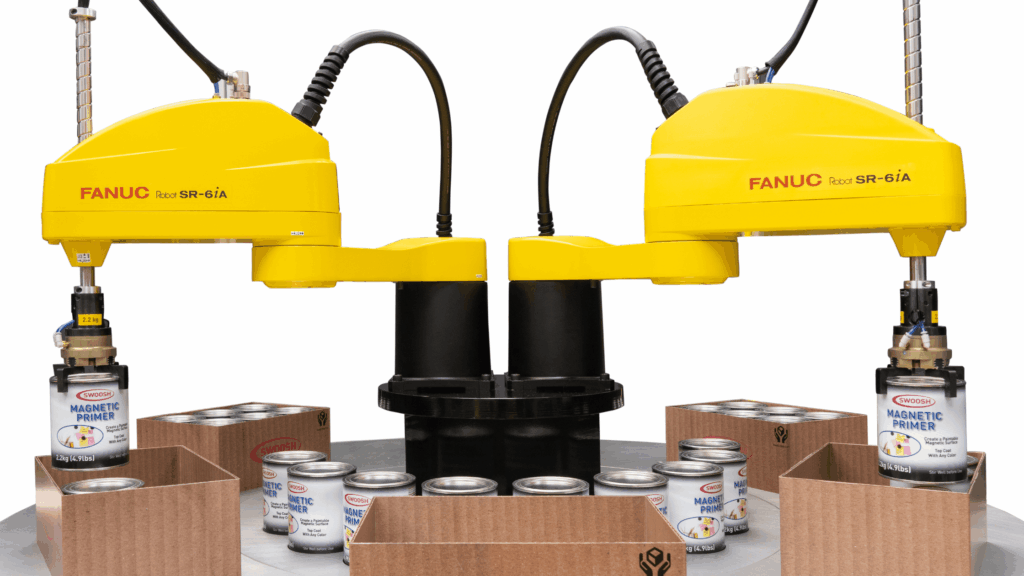
What is End-of-Line Packaging Automation?
The complete end-to-end packaging process typically involves placing product into primary packaging, such as a bottle or box, encasing groups of those items inside a secondary protective layer – usually a cardboard case – and finally bundling sealed cases into secure bulk packaging for safe transport.
End-of-line automation manages the final stages of this process, such as case packing, sealing, and palletizing/depalletizing. Automated end-of-line packaging solutions often use industrial robots or collaborative robots (cobots) equipped with specialized end-of-arm tooling to handle repetitive tasks with speed and precision.
As the market for packaging automation continues to grow, integration with vision systems designed to handle end-of-line tasks such as bin picking and handling multiple SKUs is defining the future of flexible end-of-line automation systems.
Why Invest in End-of-Line Packaging Automation?
End-of-line packaging automation provides significant benefits for packaging operations, including:
- Maximized Productivity and Throughput: Robots run 24/7 without breaks or fatigue, significantly boosting efficiency, productivity, and output.
- Enhanced Worker Safety: Automation eliminates dull, dirty, and dangerous tasks like heavy lifting and repetitive stacking, mitigating risk and injury claims.
- Guaranteed Consistency and Quality: Automation achieves precision and repeatability that can’t be matched by manual labor, resulting in fewer damaged goods, reduced scrap rates, and lower operating costs.
- Adaptability to Labor Challenges: Automation systems offset labor shortages by providing an autonomous system for medium-to-high volume applications where labor is scarce.
Advantages and Disadvantages of Automatic Packaging
Integrating end-of-line automation for packaging offers enough advantages to offset perceived disadvantages.
Advantages of Automatic Packaging
Maximum Efficiency and Speed: Automating tasks with speed and high levels of accuracy achieves faster cycle times.
System Flexibility and Customization: Easily reconfigure robotic systems to accommodate evolving packaging needs or handle multiple SKUs on a single line.
Reduced Operating Costs: Automation helps lower operating costs over time and minimizes product damage expenses, making it a cost-effective solution.
Unmatched Quality: Enhancing precision and repeatability through automation ensures products are stacked and packaged to exact specifications every time.
Disadvantages of Automatic Packaging
Initial Capital Investment: While there is a significant upfront cost to integrating automation, long-term ROI achieved through optimization of the process (increasing throughput and cutting operational costs) makes it a cost-effective, financially justifiable investment.
Complexity of Integration: Integrating automation in-house is indeed a complex process, but you don’t have to go it alone. The experts at JHFOSTER are here to handle the complex design, programming, and integration for you.
End-of-Line Automation Applications and Industries Served
End-of-line automation solutions from JHFOSTER, including robotics, end-of-arm tooling and the compressed air and vacuum components that power them, are versatile enough for use in packaging applications across multiple sectors:
- Food and Beverage: Clean, precise handling of sensitive products and packaging.
- Manufacturing and Industrial: High-volume handling of raw materials and finished parts.
- Consumer Packaged Goods (CPG): Rapid sorting and placement for varied product lines.
- Automotive: Handling of components and finished goods for shipping.
Meeting Safety and Quality Standards
Partnering with JHFOSTER for your end-of-line automation solutions assures that all quality and safety standards are met.
Machine Safety Standards: We follow established industrial machinery safety requirements so your employees are protected from occupational injuries and accidents.
Collaborative Robot Safety: JHFOSTER uses cobots that meet ISO standards for safety and usability, ensuring the safest human-robot shared workspaces.
Enclosure and Component Ratings: Equipment installed by JHFOSTER is designed to meet industry-specific Ingress Protection (IP) ratings, such as IP69K ratings for food and beverage applications. This assurance is critical for automated equipment located in washdown or dusty environments.
Your End-of-Line Automation Partner: JHFOSTER
At JHFOSTER, we are more than a distributor. We are your partner in automation, providing full lifecycle support from consultation to ongoing service. We evaluate, design, integrate, and support your end-of-line packaging solution from start to finish.
Ready to optimize your end-of-line packaging process? Request a quote from JHFOSTER today to discuss a customized solution for your application so you can start packaging with higher levels of efficiency at a lower cost.