A Guide to Collaborative Robot Standards, Hazards and Compliance
Collaborative robots, or cobots, are crucial for manufacturing productivity. Cobots are designed with built-in safety features so they may work collaboratively alongside human workers, but these technologies do not ensure safety “out of the box.” Rather, a comprehensive, application-specific risk assessment is essential to safeguarding your workforce and achieving compliance.
As your partner in automation, JHFOSTER provides the design, evaluation, integration and support services that are necessary for the safety and compliance of your collaborative robot application.
How Are Cobots Safe?
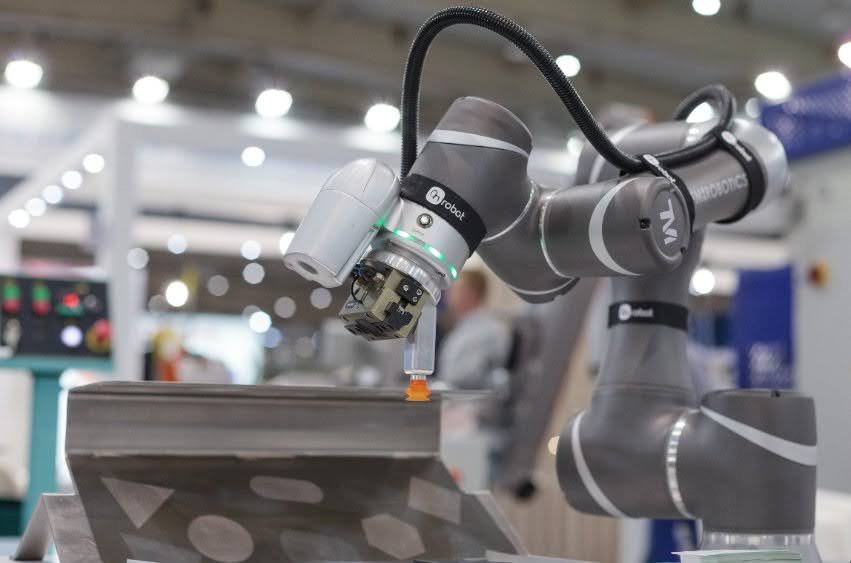
This new generation of industrial robots is considered safer than traditional industrial robots because collaborative robots offer advanced safety features, such as sensors, cameras and software programming that detect the proximity of objects or people to prevent accidents and injuries. Advanced safety features include:
- Safety-monitored stop: Sensors within the control system force the cobot to a complete stop when a human is too close and restart when the employee is at a safe distance.
- Speed and separation monitoring: This safety function, called SSM, uses sensors and cameras to detect proximity to human workers and commands the cobot to slow down to a safe speed.
- Power and force limiting technology: This feature, known as PFL, controls and reduces the cobot’s force and torque to prevent injury if it contacts an operator.
While these safety features typically enable cobots to be placed in areas shared with human operators without safety guarding or enclosures, the entire application, including integrated equipment, the work cell, and workflow, and accessories such as end-effectors, must be evaluated for safe operation. For this reason, a risk assessment of the whole automation system is needed to ensure compliance with industry safety standards for robotic installations.
What are the Safety Standards for Cobots?
Several industry safety standards are applied to robot and cobot installations, including:
ISO 10218
ISO 10218 from the International Organization for Standardization is the most recognized guideline for industrial robot safety. The most recent version of ISO 10218 covers the safety requirements for industrial robots for manufacturers and for industrial robot applications.
ISO 10218 provides functional safety requirements with precise guidelines around compliance and risk mitigation. Integrated safety requirements for collaborative robots that consolidate the previously separate ISO/TS 15066 are included in ISO 10218.
Additionally, safety guidance for manual load/unload procedures and end-of-arm tooling has been incorporated from previously separate technical reports, TR 20218-1 and TR 20218-2, as have new robotic classifications with corresponding functional safety requirements and test methodologies.
ANSI R15
The American National Standards Institute (ANSI) has adopted ISO 10218 as part of its ANSI R15, which outlines safety requirements for the use of industrial robots, as well as robotic integration into work cells.
OSHA
Although the Occupational Safety and Health Administration (OSHA) does not have specific standards for the robotics industry or automation integration, the agency relies on ISO, ANSI, and other relevant industry standards governing risk assessments, safeguarding, and other related hazards in the workplace.
As your expert automation partner, JHFOSTER provides compliant integration and support for your cobot application, ensuring workforce safety and compliance with industry standards.
What are the Primary Hazards Associated with Robots?
OSHA has identified eight primary hazards in robotic applications, including:
- Human error: When operators place themselves in hazardous locations/positions.
- Control errors: Hazards in the robotic work cell caused by errors in the control software or hardware.
- Unauthorized access: An unauthorized/untrained operator entering the robotic work cell.
- Mechanical failure: Unexpected mechanical malfunctions that create hazards.
- Time pressure: When rushed, workers may bypass safety protocols.
- Environment: Environmental factors may interfere with robotic function.
- Power failures/malfunctions: Power disruptions or failure to follow lockout/tagout procedures may interfere with operation or release energy, creating electrical hazards.
- Improper installation: Poorly designed and improperly installed robotic systems can result in operational hazards.
According to OSHA, proper design, testing, integration, operation, and maintenance of the robotic application can prevent these issues. As your experienced partner in automation, JHFOSTER can help you avoid these hazards.
The 4 Main Types of Robot Accidents and How to Avoid Them
The four main types of robot accidents include:
- Impact/collision accidents: When an operator is struck by the robot, end effector, or material handled by the robot.
- Crushing/trapping accidents: When an operator is pinned between the robot and another surface or trapped by the robot itself.
- Mechanical part accidents: Failure of the robot’s parts or safety devices that result in injury.
- Other accidents: Flying parts, being caught between machine parts, component failure, etc.
How to Avoid Robotic Accidents
The majority of automation-related accidents can be avoided using the following precautions:
- Risk assessment: A comprehensive risk assessment prior to installing a robot in a work cell, as well as after installation, will help identify potential risks so preventive measures may be taken.
- Proof of Concept Testing: This helps identify potential hazards that may not show up in simulations.
- Safety devices: Safeguarding operators from hazards with devices such as guarding and light curtains for traditional industrial robotic cells, and using advanced safety features of cobots can prevent accidents.
- Proper design, installation, and integration: Ensuring the robotic work cell has been designed, installed, and integrated with safety compliance in mind will prevent many hazards.
- Training/procedures: Thorough training for operators, maintenance techs, and other employees provides risk awareness and details on safety precautions and procedures.
- System maintenance: Ensuring that all components of the robotic cell are in good working order will prevent accidents related to malfunctions.
What are Some Safety Rules to Follow when Working with Cobots and Robots?
While safeguards and safety procedures will vary from application to application, these six rules should help prevent robot/cobot-related accidents.
- Always perform a comprehensive risk assessment.
- Perform physical testing to validate robot/cobot force limits.
- Manage stored energy and practice lockout/tagout procedures.
- Properly secure end effectors.
- Maintain an unobstructed workspace.
- Never bypass safeguards or safety devices.
Creating a Safe Work Zone: Speed and Separation
Built-in speed and separation safety features are what differentiate cobots from robots and allow them to collaborate safely with human operators.
What is a Safe Speed for a Cobot?
The industry-recommended speed limit for a cobot in true collaborative mode (where human contact is possible) is 250 mm/s or less, as defined by ISO/TS 15066/ISO 10218. This speed permits force limitation if a collision occurs.
However, a comprehensive risk assessment of the specific application will determine the safest speed. Higher speeds may be possible if features, such as speed and separation monitoring or non-collaborative modes, are employed.
What is the Safe Zone Around a Robot?
The safe zone around a robot depends on the type of robot, its speed, operational mode, and application, and should be defined during the risk assessment.
Traditional industrial robots require physical barriers like fencing and cages to keep employees at a safe distance and/or sensor-based devices such as light curtains that halt operation when an operator enters the area. A comprehensive risk assessment and industry standards will provide information on what type of safeguards are needed for an application.
Collaborative robots generally do not require physical barriers when working in a collaborative space, which is a defined area in which the cobot can safely operate when equipped with speed and separation monitoring, safety-monitored stop, and/or PFL technologies. Following a comprehensive risk assessment for the application, the cobot should be programmed to maintain a defined safety boundary (a programmable, virtual wall that relies on sensors to trigger cobot safety features when the boundary is breached) to ensure a safe working zone.
JHFOSTER, Your Partner in Compliant Robotic Integration
As your partner in automation, JHFOSTER has the expertise to navigate complex cobot safety standards and custom-design a compliant, reliable, and safe solution for your application. Contact us today to increase efficiency and ensure cobot safety.