How to Integrate Cobots into Manufacturing
Today’s manufacturers face labor shortages and sharp cost increases. Collaborative robots, also called cobots, provide a powerful solution because they allow you to better leverage the skills of your existing workforce. This guide will walk you through the “what,” “why” and “how” of successful cobot integration so you can begin working more cost effectively.
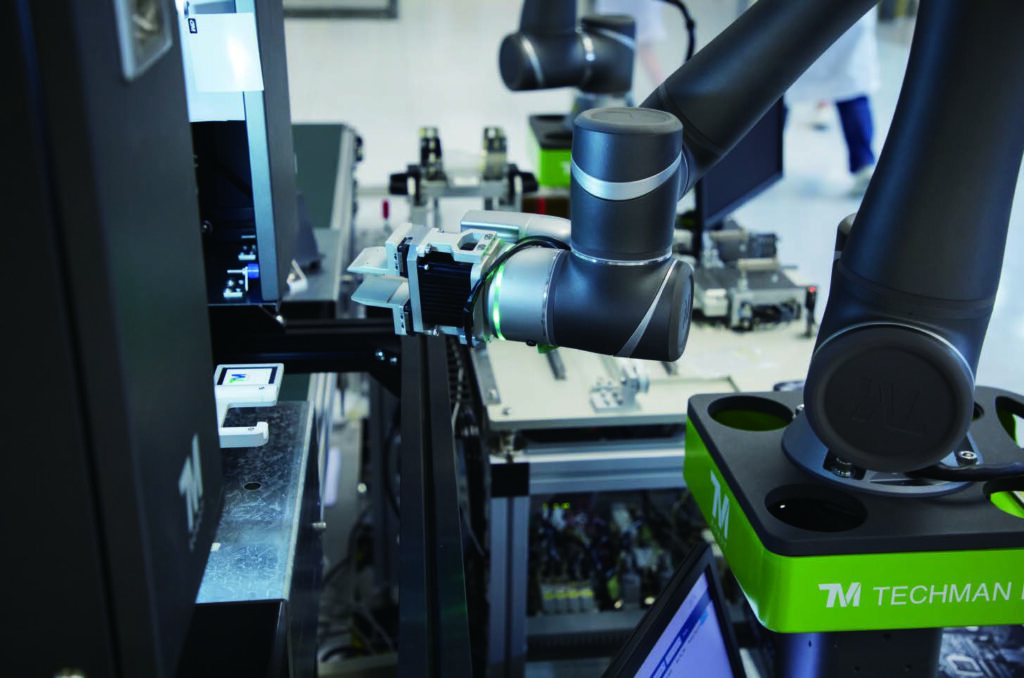
What is Cobot Integration?
Integration involves more than just buying a robot and plugging it in. It is the process of making the cobot a functional component in your existing workflow so it works safely and efficiently alongside your human workers. To get optimal performance from a cobot, the integration process involves a risk assessment, programming and connecting the cobot to other machines in the process.
Cobots vs. Traditional Robots: Why Cobot Integration is Easier
There are significant differences between traditional industrial robots versus collaborative robots, including a less complex integration process and higher levels of safety. Here’s the breakdown.
Traditional Industrial Robots
Industrial robots are powerful and fast moving and do boost factory floor efficiency. However, they are hazardous to be around, so they require elaborate safety devices and cages, which add more cost and complexity to the integration process. In addition, programming traditional industrial robots is complex and requires the skills of a professional programmer.
Collaborative Robots
The most significant difference between a traditional robot and a cobot is that cobots are designed to safely share workspace with human employees. Cobots are equipped with sensors and cameras that help detect the presence of humans and obstacles and can limit their speed, power and force when needed.
Thanks to these safety-minded design innovations, cobots do not require safety guarding, so they can be integrated more easily, deployed faster and cost less.
In addition, programming is simple. Many cobots, such as those from Techman Robots, can be programmed by holding the “Free-Bot” button on the wrist and physically moving the arm to program way points. This means no expert programmer is needed.
7 Steps for Successful Cobot Integration
The following roadmap for integration guides you through proper integration of a cobot, ensuring you get the expected results and boosting the success of your automation project.
1. Set Goals and Define KPIs
Before beginning the project, it’s important to know what problems you’re solving, such as labor shortages, high-error rates or bottlenecks. Understanding what success looks like is also key. It may be that you want to increase machine utilization by 20% or boost throughput by 10%.
2. Identify the Best Application
When deciding to integrate a cobot, finding the right application is critical to success. Repetitive, low-value tasks, such as machine tending (loading and unloading), material handling, assembly, dispensing and inspection, make a great starting place for cobot integration.
3. Choose a Suitable Cobot and Perform a Risk Assessment
Once you’ve identified the task the cobot will automate, select a cobot that meets the payload, reach and speed requirements of the application.
Even though cobots are inherently safe, you must conduct a risk assessment to identify potential hazards and install necessary safeguards to fully ensure the safety of your workforce. Remember, while the cobot itself is designed to do no harm, the tool it may be holding, such as a knife or an abrasive wheel, can be hazardous and all hazards must be mitigated.
4. Design and Simulate the Workflow
Next, plan the layout of the automated cell. Where will the cobot be located? Where will raw materials come from? Simulating the intended process will identify any potential collisions or inefficiencies before the equipment is installed.
Ensure that the cobot manufacturer has performed a Factory Acceptance Test (FAT) to verify that the cobot meets the design specifications. And, a Proof of Concept (POC), a preliminary test during the early stages of the project, will validate the feasibility of the project.
5. Perform the Physical Integration and Programming
The cobot can now be installed. Thanks to their simple programming, such as the flowchart-based systems on Techman robots, the integration and programming process is faster and easier than with traditional industrial robots.
6. Train Your Employees
Show your team how to work with and program the cobot. In addition to improving the workflow, this increases job satisfaction and alleviates workforce concerns about personal safety and job security. The key takeaway for employees should be that employing cobots for repetitive tasks leverages their skills for more complex, value-added tasks.
7. Monitor, Evaluate and Optimize
Once the cobot is up and running, measure its performance against the KPIs you set in Step 1. Use collected data to make any necessary adjustments to the workflow. Cobots are flexible and can be moved, mounted to AGVs or reprogrammed for different tasks as your needs change.
The Tangible Benefits of Cobot Integration
The power of cobot integration lies in the advantages they bring to the factory floor, including:
- Higher labor productivity
- Increased machine utilization
- Higher output rates
- Improved quality
- Short payback/good ROI
- No expert programmer needed
- Lower operator fatigue
- Increased operator job satisfaction
Understanding the Types of Cobots
International Organization for Standardization (ISO) 10218, the most recognized guideline for industrial robot safety, provides parameters regarding the safe design, installation and use of robots. According to ISO 10218, there are four types of cobot operation used to ensure safe human robot collaboration in shared workspaces, including:
- Power and Force Limiting (PFL): This is what most people think of as a cobot. They are lower-powered machines with collision detectors. Techman robots are a key example.
- Safety Monitored Stop: Cobots with this technology use sensors to stop the robot when a human comes too close.
- Speed and Separation: Speed and separation-based cobots use cameras to measure human proximity so the robot slows down when needed.
- Hand Guided: Here, the arm is directly steered by a human, usually to bear the weight of a heavy tool.
Your Partner in Cobot Integration
JHFOSTER is more than a distributor, we are an automation partner who will support you through the entire lifecycle of your automation project. Our experts can evaluate, design, engineer, integrate and service your entire system.
If you’d like to explore the potential for cobots in your manufacturing operation, JHFOSTER can help. Contact us to arrange a consultation with one of our robotics applications specialists. Curious about the ROI of a potential automation project? Try our free Robotics ROI Calculator.